Athlon Ares ETR 4.5-30x56 Review
The Athlon Ares ETR 4.5-30x56 is an impressive 34 mm scope featuring a 56 mm objective and a first-focal-plane mil reticle. With one click measuring 0.1 mil and one full turn representing 10, this riflescope provides 32 mils of elevation in the turret, which amounts to three complete turns, in addition to a zero stop and a windage lock. The tan finish adds a distinctive touch, designed to dial farther than most hunting rifles ever require.
Using a 26-inch 6.5 Creedmoor paired with a 130-grain Sierra GameKing, you can reach 1,000 yards with only 8.6 mils of elevation adjustment, which means that the vast majority of the turret remains unused. Compared side by side with a Vortex Strike Eagle, the Athlon Ares ETR remains the more user-friendly scope to remain behind, impressively retaining clarity after recoil. You can count the audible clicks with ease, whereas the Strike Eagle often requires you to reorient the glass after each shot.
At 4.5x, there's ample window to locate an animal and effectively point your rifle. By 30x, you can confidently settle the crosshair before returning your focus to a lower magnification. However, you won't stay at 30x longer than the shot requires.
When it comes to value, the Athlon Ares ETR is one of the top hunting optics available under the $2,000 mark. The current UHD model is priced around $1,300, significantly lower than its $1,625 list price, which reflects substantial savings compared to many competitors like the Razor.
What you receive for your investment is typically what costs an additional thousand dollars. The 34 mm tube, 32 mils of travel, a practical zero stop, a locking windage feature, and a turret that's easy to track are all excellent components. The glass quality is surprisingly clear for this price range; the edges remain sharp, and color accuracy is on point, even in low light conditions, providing visibility for tracking your GameKing's impact without difficulty. It holds its own against $2,500 scopes, ensuring you don’t feel like you compromised on quality.
If your budget is below two grand and you want the best potential scope within that range, the Athlon Ares ETR makes a compelling option, providing impressive travel, audible clicks, and a crystal-clear image that belies its price point without simply purchasing a brand name.
In terms of elevation travel, 8.6 mils stays within the first revolution of adjustments. Once your dope is dialed in, you’ll have an additional 1.4 mils remaining in the turn, plus another 22 mils available behind it. This means a total of 23.4 mils is available that this particular bullet will unlikely require.
Using a heavier, slower bullet, or a shorter barrel could consume more of this travel, while a more aerodynamic 140-grain bullet from the same 26-inch barrel would use less. Regardless, you won't find yourself needing the zero stop halfway through the dope card. If the Creedmoor is the only rifle for the Athlon Ares ETR, two of the three available turns will be extra. If your next rifle is a .308 or a short barrel, those extra adjustments could become useful.
At a distance of 100 yards, the field of view measures approximately 24 feet at 4.5x and about 3.75 feet at 30x. The side knob focuses from 25 yards to infinity, allowing for versatility in shooting whether you are in dense timber or across expansive fields.
For parallax adjustment, the knob on the left is clearly marked from 25 yards to infinity. Turn it until your target appears sharp; this is the main part of your task.
The additional challenge is ensuring that the crosshair remains fixed on the target as your head shifts. Once you set the knob, try shifting your cheek slightly. If the crosshair remains on target, you're all set. However, if it drifts off your aim point, simply readjust the knob and retest.
The effect is more pronounced at higher magnifications. At 4.5x, a slight misalignment can still keep the animal within the crosshair. Conversely, at 20x or 30x, an incorrect parallax adjustment can cause the crosshair to wander if your head isn’t correctly positioned after each shot.
During your hunt, set the parallax for the distance you anticipate shooting and leave it. You won’t want to make adjustments while waiting for a buck. If the shot unexpectedly turns long-range, extend the knob toward the maximum range before dialing in. If you’ve left a setting fixed at 100 yards, a 1,000-yard target might appear blurred, causing the crosshair to move out of alignment with your head movement.
Inside 25 yards, the focus doesn’t sharpen any closer, but this isn’t typically an issue when using the Athlon Ares ETR on this rifle. From 25 yards outward, it effectively addresses the range this Creedmoor mainly sees.
When comparing, the Athlon’s eye relief measures between 3.9 and 4 inches, whereas the Strike Eagle offers just 3.7 inches. While this may seem negligible, the difference becomes significant after a few rounds.
Behind the Athlon Ares ETR, you’ll find comfort to stay in position, as the picture remains full and vibrant even after recoil. The Strike Eagle requires your head to stay in one fixed position; post-shot, you’ll need to realign. After every recoil, you may find yourself displaced from the glass, and the eye box doesn’t assist in reestablishing focus. On a hunting rifle, especially without a rear bag, that can become quite inconvenient.
As you crank up the power on both scopes, the image tightens. At 30 power with a 56 mm objective, you’re looking through a small hole. The additional eye relief provides slightly more latitude to find the picture, and on this rifle, that made a crucial difference.
The turret clicks on the Athlon are both tall and easily audible. You’ll be able to dial 8.6 mils, which translates to 86 clicks, without the need to keep your eyes glued to the dial to confirm movement. Conversely, the Strike Eagle requires you to check the dial afterward, as you may not be sure if you’ve actually registered a click.
This becomes a critical factor when using shooting barricades or supports, where you can’t look directly at the turret. The Athlon Ares ETR allows you to count your clicks, while the Strike Eagle often necessitates a verification check.
With windage locks in place, the turret remains secure even if your rifle is bumped while being carried in a truck or against a tree. The zero stop provides a definitive return to your hunting zero. With three turns of travel available in the scope, this stop is essential; you don’t want to be two turns up the turret, uncertain about which click indicates home when game is present at 200 yards.
Regarding aesthetics, the tan finish remains consistent whether in sunlight, shade, or taken out of its case. It looks appealing and doesn’t attempt to blend into the rifle. Standing out on any chassis, it quickly becomes noticeable on a black firearm as soon as the case opens.
While it won't decrease the drop of the 130-grain bullet, hunters seeking a scope that seamlessly integrates into their rifle may not prefer it. For those who appreciate a scope that visibly stands out as a deliberate choice, this tan finish delivers that look and maintains its appearance even after being stored in a case.
In summary, the Athlon Ares ETR boasts UHD glass, a 34 mm one-piece tube, is argon purged, features an illuminated reticle, weighs 36.8 ounces, and measures 15.3 inches in length, alongside a lifetime warranty. The side focus ranges from 25 yards to infinity. On this 26-inch Creedmoor, a 130-grain GameKing requires 8.6 mils from a 32-mil turret to achieve 1,000 yards.
For the price, often below $2,000 and more commonly around $1,300, the clarity of the image exceeds expectations, while the turret functions as well as those found in much pricier models. Simply set the parallax for the intended distance, adjust your head once to ensure the crosshair remains steady, and then dial in your shot. The Athlon Ares ETR allows you to maintain your sight picture without the interruptions that the Strike Eagle creates, requiring constant adjustments. The turret clicks are reliable, and the tan finish is the first thing noticed by onlookers.
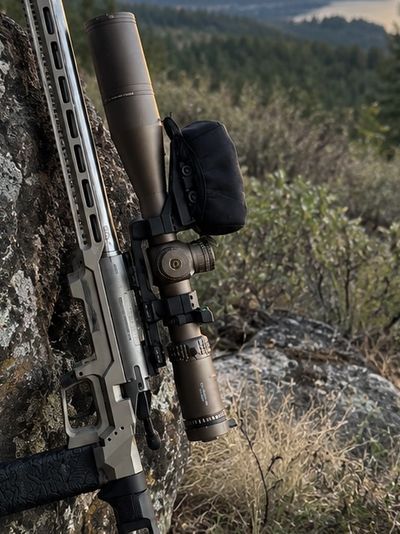
Precision rifle with scope resting against a rock.